Student-Level Insights
Written By Christopher Lee
Last updated About 1 year ago
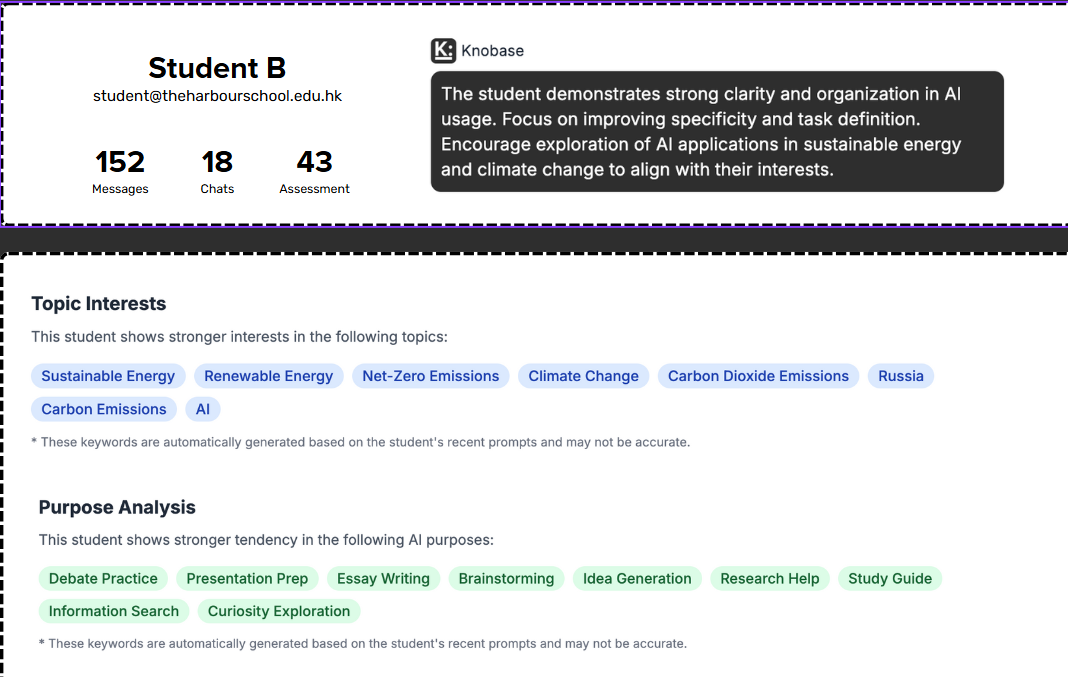
Knobase’s analytics dashboard provides deep, personalized insights into each student’s interaction with AI agents. These insights help educators tailor support, identify learning gaps, and promote student growth through data-informed decisions.
🧠 Why Student-Level Insights Matter
✅ Reveals individual learning preferences and engagement trends
✅ Identifies students who may need academic or emotional support
✅ Enables personalized teaching strategies and interventions
✅ Supports holistic student development through AI usage data
⚙️ How It Works
Individual Usage Reports
Each student has a dynamic profile that tracks:Number of prompts submitted
Most discussed subjects
Time of day AI is most used
Prompt quality (clarity, specificity, structure)
Emotional tone and sentiment trends
Engagement Metrics
Teachers can view:Frequency of AI interactions
Recurring confusion areas (e.g., “struggles with fractions”)
Expressed interests (e.g., “asks about climate change, public speaking”)
Preferred learning formats (e.g., visual, text-based, inquiry-driven)
Well-being Indicators
The system flags:Emotional distress signals (e.g., “I feel overwhelmed”)
Isolation patterns (e.g., frequent late-night queries)
Sudden drops in engagement or tone shifts
Actionable Recommendations
Based on the data, Knobase suggests:Clubs or enrichment programs (e.g., “ESG club for climate-interested students”)
Academic support (e.g., “math tutoring for repeated confusion in algebra”)
Counseling referrals (if emotional flags are triggered)
💬 Example Insight
Student A frequently asks about historical debates and global issues.
✅ Recommendation: Invite to Model UN and debate team.
Student B shows declining prompt quality and late-night usage.
✅ Recommendation: Check in with counselor and offer study support.
📊 Use Cases 🧑🎓 Students: Receive personalized learning support and enrichment opportunities
🧑🏫 Teachers: Understand student needs and adapt instruction accordingly
🧑💼 Admins: Monitor school-wide engagement and identify at-risk students